Mission Statement:
Inspiring unity through adaptive conservation.

Our “Star-Spangled Banner”

Understanding History
A bombardment from sea and the burning of the Capitol.
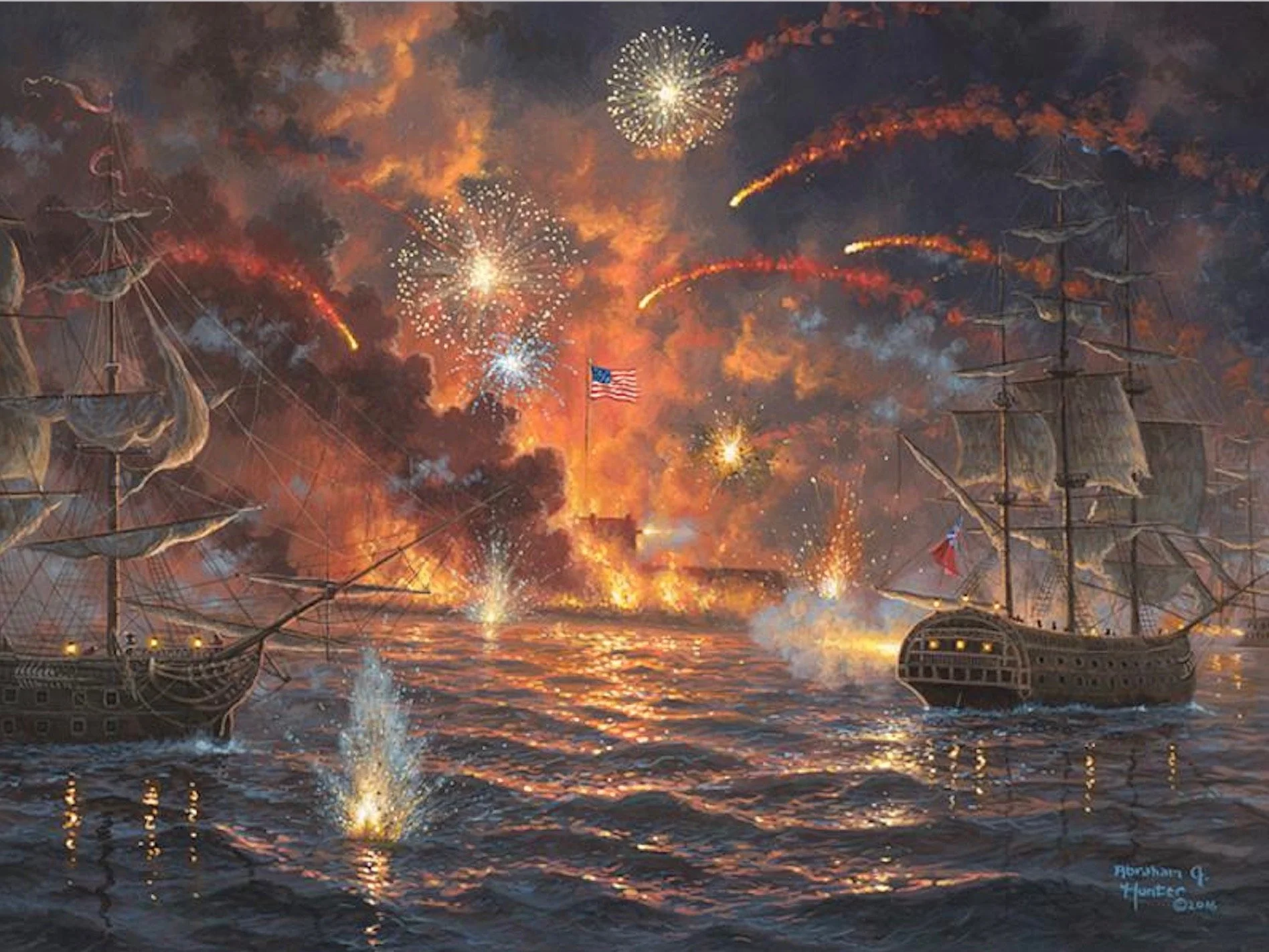
One might ask why Francis Scott Key, the author of “The Star-Spangled Banner”, passionately diverts our attention in his historic battle song to a band of mercenaries and slaves as the foul foe deserving of the most scrutiny in the 25+ hour attack on our Star Fort. In his third verse, it’s difficult to understand why the fierce British fleet, with their 55 vessels and 17 warships, was not the unquestionable enemy within Baltimore Harbor. One could offer many explanations for the author’s convictions as he enthusiastically detailed the events just witnessed:
Perhaps during Key’s 7-day detainment at sea he carefully considered his situation aboard the enemy’s ship while watching the bombardment ensue. Then later, following his release without harm, could it be that Key felt he owed England a softer criticism regarding the battle — thankful that his life was spared, he may have simply opted to point his pen at the lowest ranking British troops who fought on land during the attack, in place of proclaiming victory over the naval commanders who had so graciously just set him free, along with his two acquaintances.
Or, perhaps because the Royal Navy was known to be suffering a manpower shortage at that time, due to the the Napoleonic Wars, Key was simply using a derogatory term to describe the British military — as a band of mercenaries, or “hirelings”, and “slaves”. We may never know the full truth.
According to historical documents it should be noted that without help from the escaped colonial slaves who signed allegiance and fought for England to earn their freedom, who are known to have led British troops deep into Washington through various waterways to conduct night attacks and surprise American camps, it was highly unlikely that England would have succeeded only a week prior in the burning of both the White House and the U.S. Capitol. Their assistance could explain the reason for Key’s expression of deep contempt. However, his focus appears to be directed more towards the British hirelings, since he referred to those whose “foul footsteps” on American soil were the worst of the bunch and not the escaped slaves, nor the commanders at sea firing canons and rockets their way.
In our current day, this storyline remains a cause for considerable grief throughout the Union as our beloved National Anthem continues to be protested. And while a few altered lyrics in a rarely sung verse may not dull the pain of injustice many feel as the original third verse contains the word “slave”, and yet remains protected by lawmakers, the words penned below simply offer a chance to read a slave-free version of our anthem that still keeps with the author’s patriotic theme of declaring victory over a boastful adversary.
Original Third Verse:
And where is that band who so vauntingly swore
That the havoc of war and the battle’s confusion,
A home and a country, shall leave us no more?
Their blood has washed out their foul footsteps pollution.
No refuge could save the hireling and slave,
From the terror of flight, or the gloom of the grave,
And the star-spangled banner in triumph doth wave
O’er the land of the free and the home of the brave.
Revised Third Verse, Option 1:
And where is that band who so vauntingly swore
That through havoc of war and the battle’s confusion
A home and a country shall embrace us no more?
Their blood has washed out their foul footsteps’ pollution.
No safe refuge behind could their futile siege find,
But terror of flight or the grave’s somber bind,
And our star-spangled banner in triumph doth wave
O’er the land of the free and the home of the brave.
Revised Third Verse, Option 2:
And who will retreat yet so vauntingly swore
That through havoc of war and the battle’s confusion
A home and a country shall embrace us no more?
They cow’r in defeat to escape retribution.
No safe refuge behind could their futile siege find,
But terror of flight or the grave’s somber bind,
And our star-spangled banner in triumph doth wave
O’er the land of the free and the home of the brave.


Francis Scott Key’s Speech — 20 Years Later
On August 6, 1834, in his hometown of Frederick, Maryland, Francis Scott Key partook in a celebratory dinner on the Frederick Courthouse lawn with his former law partner, fifty-seven year old Roger Brooke Taney. At one point Judge Taney stood up during the dinner and introduced Key as the author of “The Star-Spangled Banner.”
In a brief speech, Key, for the only recorded moment in his life following the War of 1812, expressed his feelings on how he came to be inspired to write his poetic song, originally titled, “Defence of Fort M'Henry.”
Herein are the words taken from Francis Scott Key: Life and Times by Edward S. Delaplaine, published in 1937.
“You have been pleased to declare your approbation of my song. Praise to a poet could not be otherwise than acceptable; but it is peculiarly gratifying to me, to know that, in obeying the impulse of my own feelings, I have awakened yours. The song, I know, came from the heart, and if it has made its way to the hearts of men, whose devotion to their country and the great cause of freedom I know so well, I could not pretend to be insensible to such a compliment.
You have recalled to my recollection the circumstances under which I was impelled to this effort. I saw the flag of my country waving over a city – the strength and pride of my native State – a city devoted to plunder and desolution by its assailants. I witnessed the preparation for its assaults, and I saw the array of its enemies as they advanced to the attack. I heard the sound of battle; the noise of the conflict fell upon mylistening ear, and told me that “the brave and the free” had met the invaders. Then did I remember that Maryland had called her sons to the defense of that flag and that they were the sons of sires who had left their crimson footprints on the snows of the North and poured out of the blood of patriots like water on the sands of the South. Then did I remember that there were gathered around that banner, among its defenders, men who had heard and answerred the call of their country – from these mountain sides, from this beautiful valley, and from this fair city of my native Country; and though I walked upon a deck surrounded by a hostile fleet, detained as a prisoner, yet was my step firm, and my heart strong, as these recollections came upon me.
Through the clouds of war, the stars of that banner still shone in my view, and I saw the discomforted host of its assailants driven back in ignominy to their ships. Then, in that hour of deliverance and joyful triumph, my heart spoke; and “Does not such a country, and such defenders if their country, deserve a song?” was its question.
With it came an inspiration not to be resisted; and even though it had been a hanging matter to make a song, I must have written it. Let the praise, then, if any be due, be given. not to me, who only did what I could not help doing; not to the writer, but to the inspirers of the song!”
…I again thank you for the honor you have done me; but I can only take the share of it. I was but the instrument in executing what you have been so pleased to praise; it was dictated and inspired by the gallantry and patriotism of the sons of Maryland. The honor is due, not to me who made the song, but to the heroism of those who made me make it…
Source: Francis Scott Key: Life and Times by Edward S. Delaplaine (New York: Biography Press, 1937), 378-380. Mr. Delaplaine’s archival source of Key’s remarks remains a mystery.